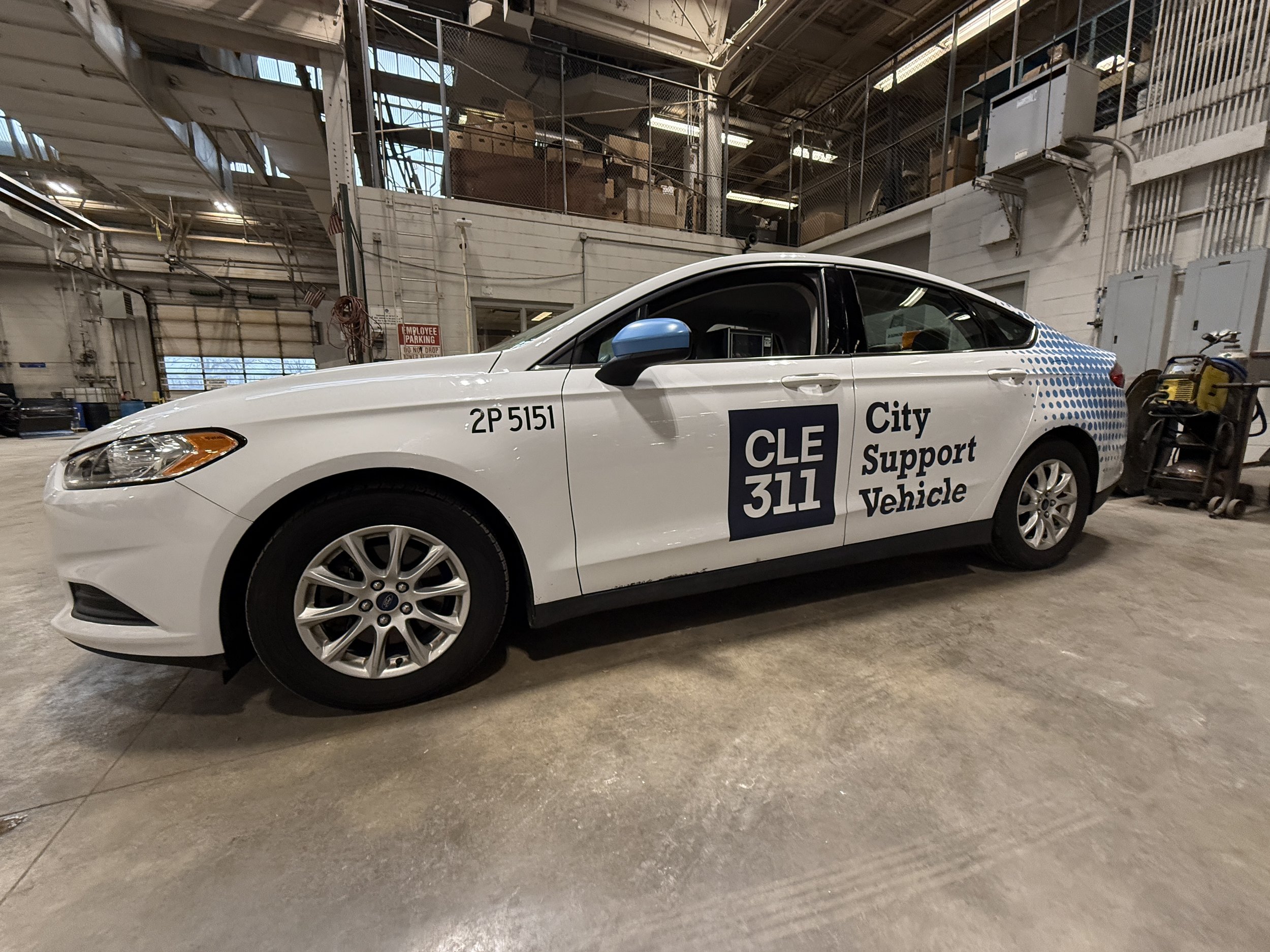
Cleveland's new 311 support vehicle is mounted with a camera and equipped with AI software to take stock of the city's housing conditions. (Abbey Marshall / Ideastream Public Media)
The parking garage at Cleveland City Hall is filled with hundreds of nondescript vehicles, but one stands out among them.
Wrapped in city branding and affixed with a mounted camera, this new 311 City Support Vehicle can do in a matter of weeks what previously took the city nine months, $170,000 and dozens of housing employees, already in short supply.
"Citywide housing surveys are few and far between, typically every five years," said Sally Martin O’Toole, Cleveland’s Director of Building and Housing. "They're very expensive and they're very labor intensive."
The grant-funded pilot program uses new artificial intelligence technology from the Alabama-based company City Detect, utilizing a mounted camera and software that captures and analyzes images of the city’s housing stock.
"If this works the way we hope it will, it allows us to do a complete survey in less than a month, which is miraculous," O'Toole said.
Cleveland's housing quality has drastically declined in recent decades, with the most recent housing survey offering an "alarming" look at the deterioration of the city's stock, according to O'Toole.
Even with the department’s lowest vacancy rate in four years, 18 unfilled inspectors remain out of 120, O’Toole said the city can’t keep up.
"There will never be enough staff to cover the city as well as we'd like to," she said.
O’Toole said most of Cleveland’s housing enforcement has been reactive. She hopes tools like City Detect can help Cleveland be proactive, especially when it comes to keeping up with the city's new vacant property registry.
"Robust enforcement of that is critical, and so monitoring the condition of houses over time, which this tool would allow us to do, is a compelling use case for us," O'Toole said.
Cleveland’s Director of Urban Analytics and Innovation Elizabeth Crow acknowledged potential privacy concerns. Residents may be skeptical of a car driving around taking pictures of their homes, but she equated it to a Google Earth vehicle capturing street view images. She ensured the software will automatically blur faces and license plates before sending the images to City Hall.
"City officials will not see license plates or faces, they will just see the condition of properties and physical infrastructure," Crow said.
O’Toole said the city won’t use that information to automatically issue citations. With 38% of complaints coming through Building and Housing found to be invalid, she sees this as a way to save employees time amid a nationwide housing inspector shortage.
"It's not going to be a robo-ticketing situation, it's not going to be more aggressive enforcement," O'Toole said. "It's just going to be more proactive enforcement where hopefully people don't have to constantly call and complain."
The city can also customize what they want the software to detect and flag for review.
"Where we see things like tires or illegal dumping, sidewalks are in disrepair; we want to get those to the right department," Crow said.
With new tech comes new fears for some residents. Although city officials haven’t reported blowback to this particular program, Clevelanders have forged petitions to resist other AI surveillance systems like Flock Safety, which links cameras, license plate readers and gunshot detectors.
City Detect is not without controversy in other places. Lauren Linder in Huntsville, Alabama, said dozens of opponents last year showed up for an hours-long public comment period at a council meeting discussing a contract with City Detect.
"While I admire the goal of a lot of the stuff that City Detect wants to do, like being able to be aware of potholes and other things that may be problematic, some of the things are not truly a problem," Linder said. "There is no victim of an overgrown lawn … I don't see the need for the whole city to be enforced that way."
The city ended up pulling the million-dollar contract proposal in September.
Unlike Huntsville, which was proposing a full-scale rollout with a dozen cameras mounted on garbage trucks, Cleveland is starting out small with the single 311 City Support Vehicle.
"Let's learn what works for us, and then we'll be able to flex," Crow said.
As for the future of AI in City Hall, Crow said this is only the beginning as Mayor Justin Bibb works to develop a strategic plan that includes training and education for all city employees.
"I would think of this technology as a tool in our toolkit," Crow said. "When you're building the house with a hammer and a screwdriver, you can get it done, but sometimes it takes you a while. This is bringing power tools to the equation."
This story was originally published by Ideastream Public Media and aired on WKSU on Feb. 13, 2026.