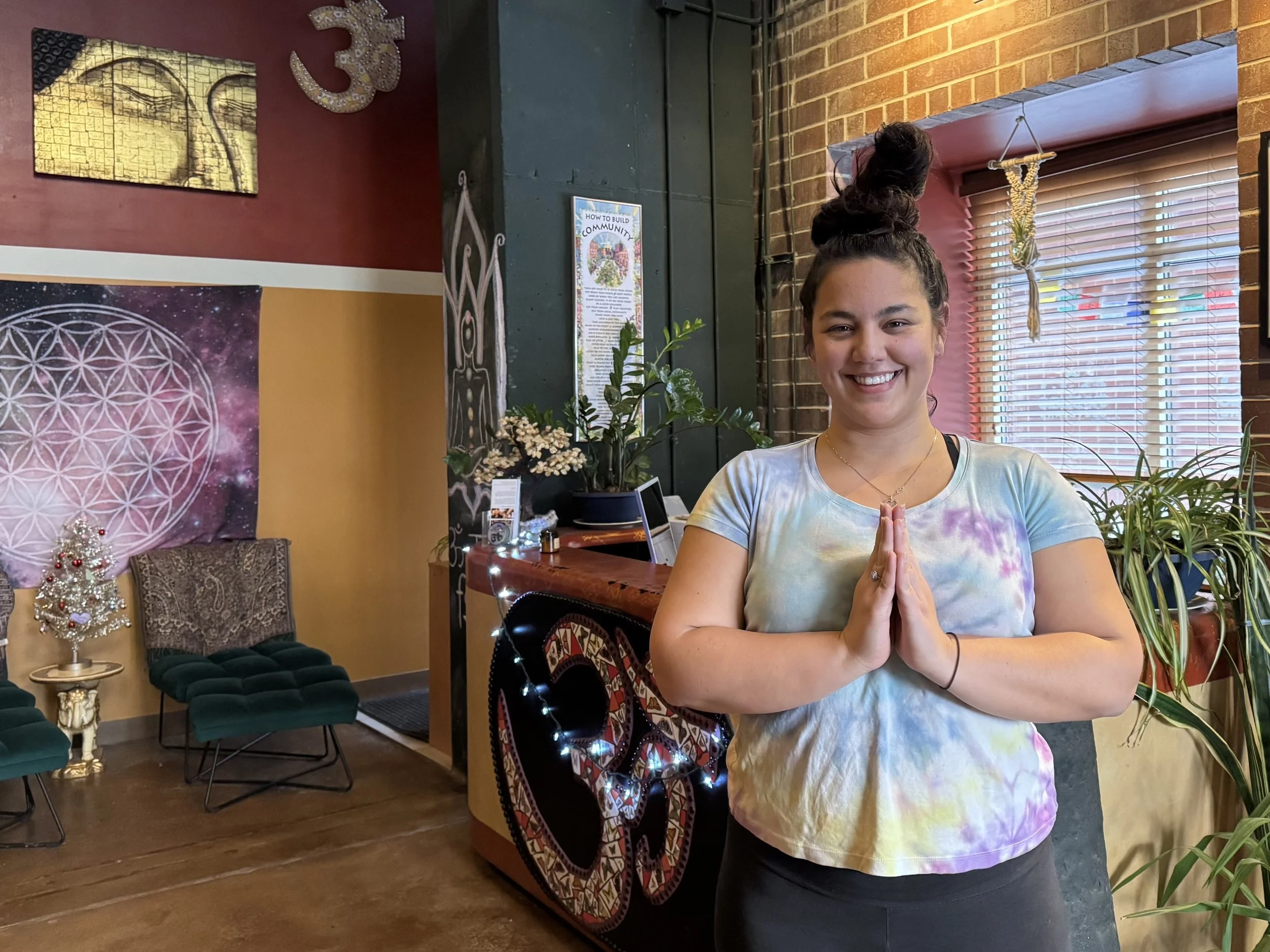
Sara Syed has owned and operated The Studio, a yoga, Pilates and aerial fitness gym, since 2018. She said the city's more expensive parking rates and expanded enforcement hours will negatively impact her staff and customers. (Abbey Marshall / Ideastream Public Media)
Maxine Mayer-Mack began her mat Pilates class at The Studio in Downtown Cleveland with guided breathwork.
"Another inhale through the nose, fill the belly up with air," she soothingly cooed.
As she instructs her students to meditate and find inner peace, Mayer-Mack is heated, and it’s not just the 100-degree room.
"I am very angry about this parking situation," she said.
Mayer-Mack used to park for free after 6 p.m. and on weekends. But now, because of the city’s new rate hikes and extended enforcement hours, it costs her $180 to park in The Flats each month.
"Which, as a low-paid worker, that is not acceptable," Mayer-Mack said.
Mayor Justin Bibb pitched the changes as a way to eventually reinvest back into city streets, though no legislation has yet come through City Council to divert that revenue, and to help small businesses.
By increasing rates from $1 an hour to $1.50, with escalating prices topping out at $4.50 in the fourth hour, he said it would increase parking turnover.
Some business owners like Sam McNulty, who owns Market Garden Brewery and six other restaurants, bars and dance clubs in Ohio City on the near West Side, said that could translate to more customers.
"You want those spaces to churn," McNulty said. "If it's free, people can just leave their car indefinitely and essentially squat in those spaces and render them inaccessible."
Cleveland’s Senior Strategist for Thriving Communities Matt Moss called the trade-off between cost and parking availability a balancing act.
"We're hearing people say like, 'I can't find a space,'" Moss said. "So what can we do? We can take steps to ensure that those spaces turn over. That comes with a trade-off, which means you might have to pay a little more to get that space."
But Sara Syed, who owns The Studio, said that bump could devastate the practice she’s operated since 2018.
"Yoga is all over the place," Syed said. "We have a beautiful studio, but if people have to start paying an extra $15 to $20 a week to come practice … they're not going to come. They're going to go to a neighboring city … We're going to lose revenue, and the city is going to lose tax revenue."
Cleveland’s parking revenue has ticked steadily upward in recent years. Last year, the city collected $1.6 million, up from $1.45 million in 2024 and $1.2 million in 2023, when Cleveland rolled out ParkMobile, an app-based payment method intended to phase out coin-operated meters. The app charges a service fee of 35 cents per transaction.
The city expects revenue to continue to climb, not only because of the rate increases, but fewer free hours; downtown drivers are now subject to seven-day-a-week enforcement until 10 p.m.
Syed is already getting complaints from customers who, in some cases, are paying more for parking than their memberships at her studio.
"What normally was free parking for me has gone to about $48 a month, which is an additional $500 a year," said longtime customer Michelle Anderson. "That's going to impact my decision on staying with The Studio when I could go somewhere else where I won't be penalized or charged."
Megan Lee, who runs the pole fitness studio École De Pole on West 9th Street said she’s frustrated by the city’s lack of notice and input opportunities.
"We've been there for almost 10 years … but we didn't receive any email, no communication," Lee said. "I had to learn about it through a silly Instagram account that I follow, so it was news to us."
Lee said the rate increases will actually drive people, and money, away from Downtown.
"Everything is more expensive now than it was when we opened nine years ago, which is to be expected, but it's to a point where I think even a small amount of money can make the difference between a student or a client showing up to your business or choosing something else to do with their time," Lee said.
The city said the new policy could be changed. Legislation approved by Cleveland City Council gives the Director of Public Works the ability to set prices based on a range instead of a hard number. As Cleveland collects data from ParkMobile, the mayor’s senior advisor Lucas Reeve said there is flexibility to change pricing and time limits based on demand.
"We feel pretty confident in that pricing structure, but we're still wanting to be responsive and empathetic to needs that come up," Reeve said. "So, we're working to develop solutions that can hopefully address some of those concerns."
The city is also encouraging employees to utilize public transit to their workplaces. The changes are being rolled out in phases across the city.
This story was originally published by Ideastream Public Media and aired on WKSU on Feb. 5, 2026.